
The Living Building Challenge
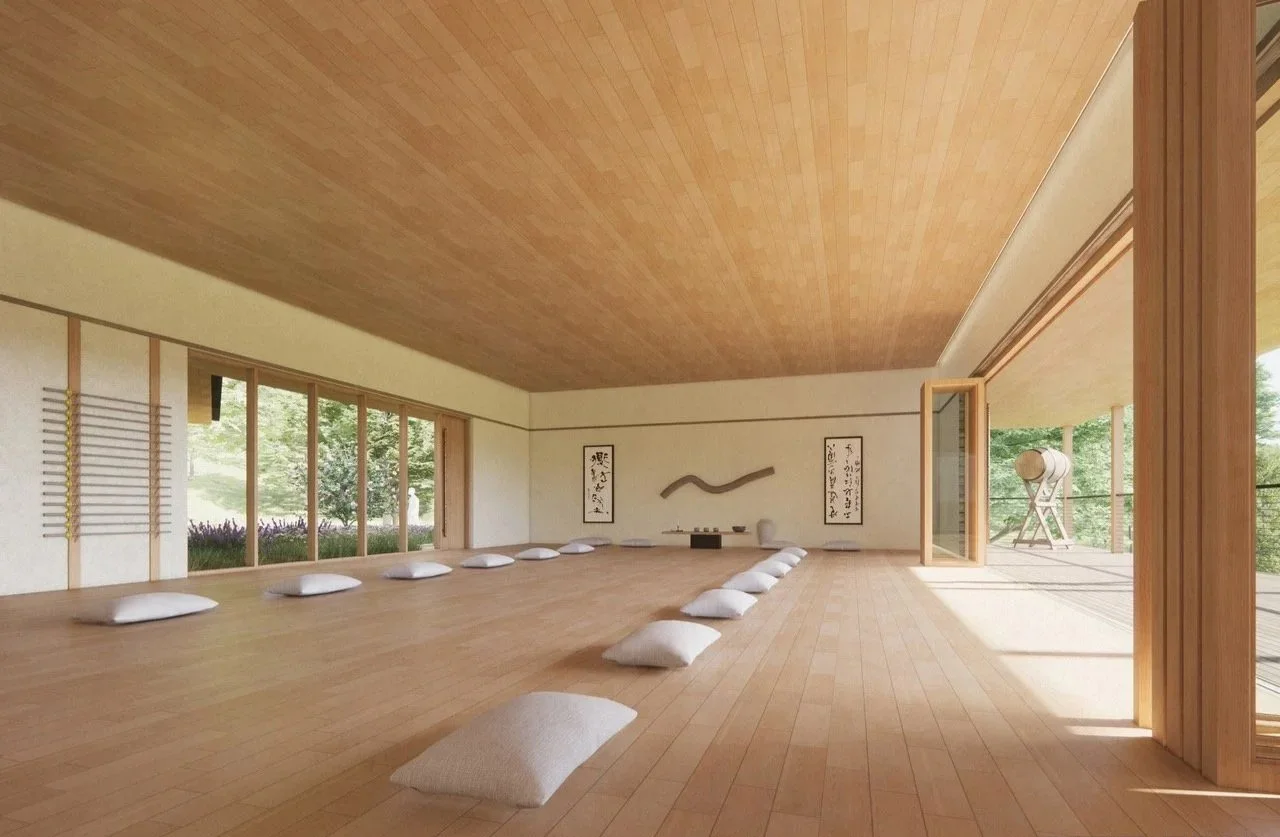
I live in a Gothic cathedral. Picture the arching branches of the walnuts along the driveway or the branches shaping the air above the Kyudo range, and you’ll know what I mean. Given the sacred quality of what I’m describing, what is our responsibility when we build? That is not a simple question. There has long been a tradition in architecture to “do as little harm as possible.” But what if the more challenging goal is to improve the locale where you design and build? That is why we have chosen to take on the Living Building Challenge as we begin development of Spring Green Dojo 2.0.
Facing challenges is one of the most natural ways by which we learn and grow. Sometimes those challenges arise by choice – I will climb that mountain – and sometimes there is no choice. You face it with everything you’ve got because the destructive power of the challenge threatens much of what you hold dear. Our rapidly changing climate has that power.
We can’t stop that change, so how do we learn to protect as much as possible? One way is to enter a deep relationship with the place you live. You learn as much as possible about the living and physical environment. And you learn how to use resources at hand in a way that is graceful. How do water, electricity, heat flow through the building?
Construction is an area that we have chosen to help address climate change. That Living Building Challenge is a sustainable building certification program that has been in existence since 2006. What makes it different from other sustainable building programs is that you must prove that your building has met sustainable targets for a year following completion before you can apply for certification.
When building to these standards, you are not just minimizing your impact on the environment with your building. You are committed to improving all that surrounds you and that is the same commitment lies at the heart of our Zen training. Think for a minute about a frequent teaching by Tanouye Roshi when he asked someone for a glass of water. He wasn’t satisfying thirst; he was tasting how much life you put into that water when you filled the glass. You learned what it meant to use everything in you to improve the taste of that water. That’s the challenge we face now with building.
There are three areas of sustainable building practice that we have chosen to use for our new Spring Green Dojo:
Water: Operating entirely within the water balance of a given climate, treating 100% of water on-site. This means that our sources of water become integrated with the uses of that water and where it goes after use.
Energy: Relying solely on 100% renewable energy generated on-site. This means extracting heat from air and ground, induction burner stoves and high-efficiency appliances in the kitchen, expanding our solar panel arrays. Whatever our use of electricity, we can’t use more than we ourselves can generate.
Materials: Utilizing safe, locally sourced, low-carbon materials free of toxic chemicals. This means using lumber recycled from buildings that we tear down. We use low-carbon cement, we source all materials from companies who have certified absence of toxic chemicals.
Building in this fashion is expensive – our architects and contractor tell us to expect spending up to 25% more on construction costs than we would be spending using the most common contemporary practices.
We are building relationships with potential donors who see this additional cost not as a luxury but as a necessity. No one of us, no government, no company, no organization will enable all to survive the impact of the changing climate. But we are committed to fostering an awareness about the impact of how we live as our contribution to the effort.
Gordon Greene, PhD
Abbot, Chosei Zen
Ex-NOAA research scientist
